About Me
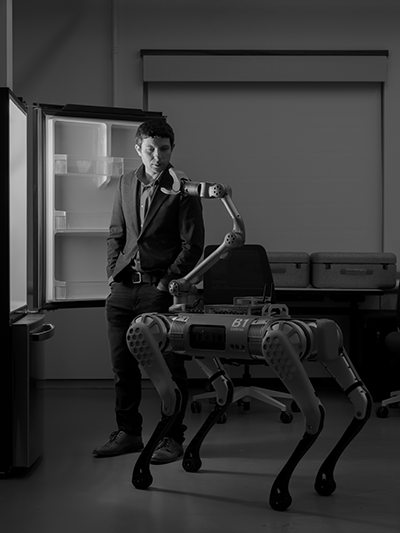
I am an Assistant Professor at Yale University in the Department of Computer Science where I lead the Applied Planning, Learning, and Optimization (APOLLO) Lab.
The high-level goal of my lab is to enable robots and learning systems to act and improve in real-time, directly within the dynamic, uncertain environments of the real world. We develop algorithms for fast optimization, planning, and control that allow systems to continuously update their behavior as they operate, tightly integrating perception, action, and learning so that robots can react quickly, gather the right information, and adapt their strategies on the fly.
Our work is motivated by domains where real-time adaptability has meaningful societal impact: home and assistive robotics, where systems must operate safely alongside people; healthcare and robotic surgery, where precision and real-time feedback are essential; and disaster response, where robots must act under uncertainty with limited prior information.

Visit the Applied Planning, Learning, and Optimization (APOLLO) Lab website for more information about our research projects, team, and open positions.
News
Curriculum Vitae
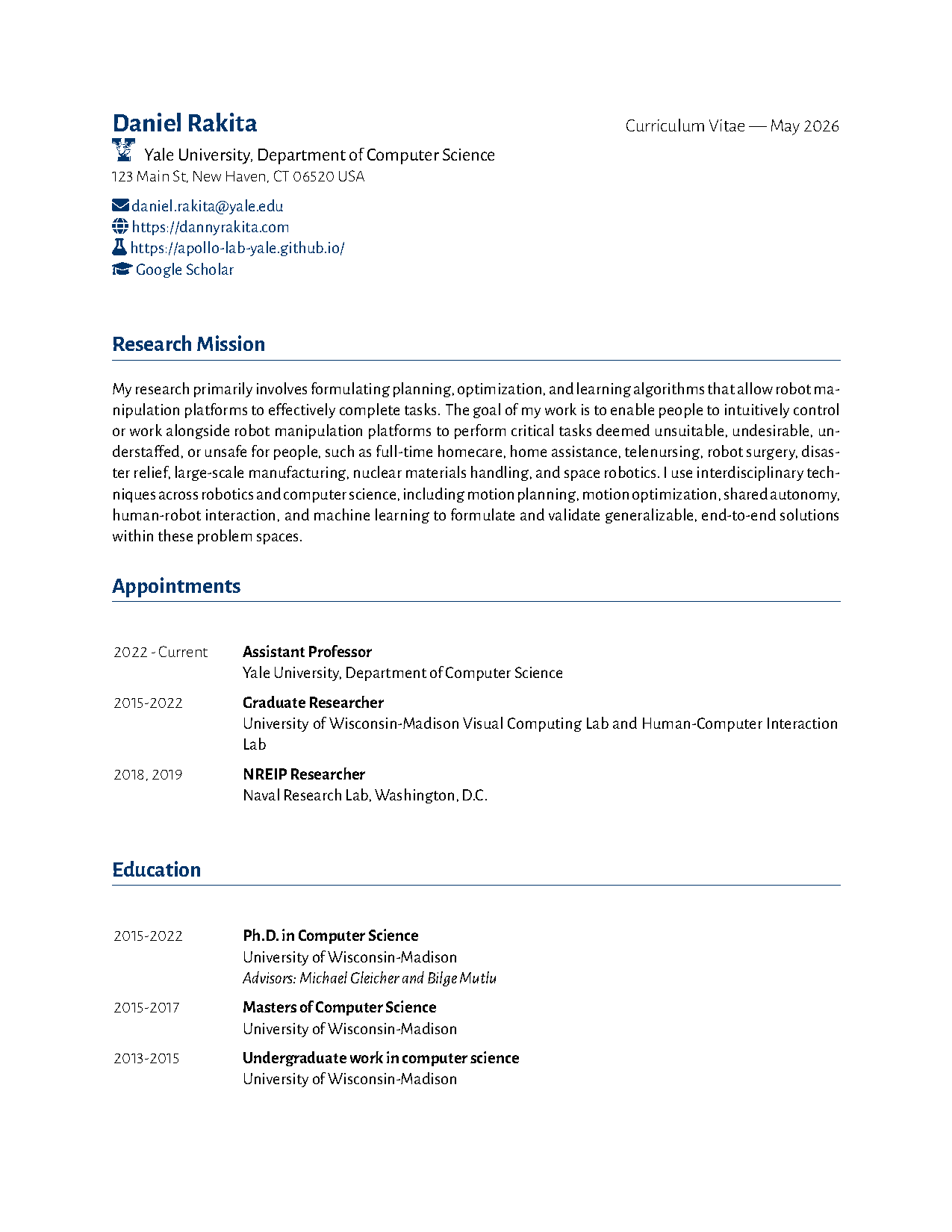
My full CV is available for download: Download PDF
Publications
Loading publications...
Awards
- Best Paper Award Winner, ACM/IEEE HRI (2023)
- Outstanding Graduate-Student Research Award, UW-Madison (2022)
- Outstanding Reviewer Award, IROS (2021)
- Cisco Graduate Student Fellowship Recipient, UW-Madison (2021)
- Three Minute Thesis Competition Finalist, UW-Madison (2021)
- Best Paper Award Finalist, ACM/IEEE HRI (2021)
- Microsoft PhD Fellowship Recipient (2019)
- Best Paper Award Winner, ACM/IEEE HRI (2018)
- NSF Graduate Research Fellowship Program Honorable Mention (2017)
- HRI Pioneer (2017)
- ACM SIGGRAPH Student Research Competition 1st Place
Teaching
Teaching is one of the most rewarding parts of my work as a faculty member. I am deeply passionate about sharing knowledge and sparking curiosity in the next generation of thinkers, researchers, and difference makers. I believe that even some of the most complex topics can be made accessible and exciting through interactive visualizations and hands-on exploration. It is immensely fulfilling to watch students develop the intuition and tools they need to push the boundaries of what is possible.
Applied Planning and Optimization
A rigorous, application-driven course covering modern planning and optimization techniques essential to robotics, computer science, and AI. Students develop both the mathematical foundations and practical skills to design and evaluate algorithms for complex real-world problems.
3D Spatial Modeling and Computing
An exploration of the mathematics and algorithms behind 3D spatial representations, transformations, and geometric reasoning. The course weaves together theory and intuition through interactive visualizations that allow students to directly observe and manipulate abstract concepts in real time.
Interactive Visualization: Inverse Kinematics Optimization
The following visualization, drawn from my CPSC 4870/5870 notes, illustrates how to optimize over spatial mappings to solve a robot inverse kinematics problem, one of my favorite examples of how math becomes more tangible through interactive exploration.